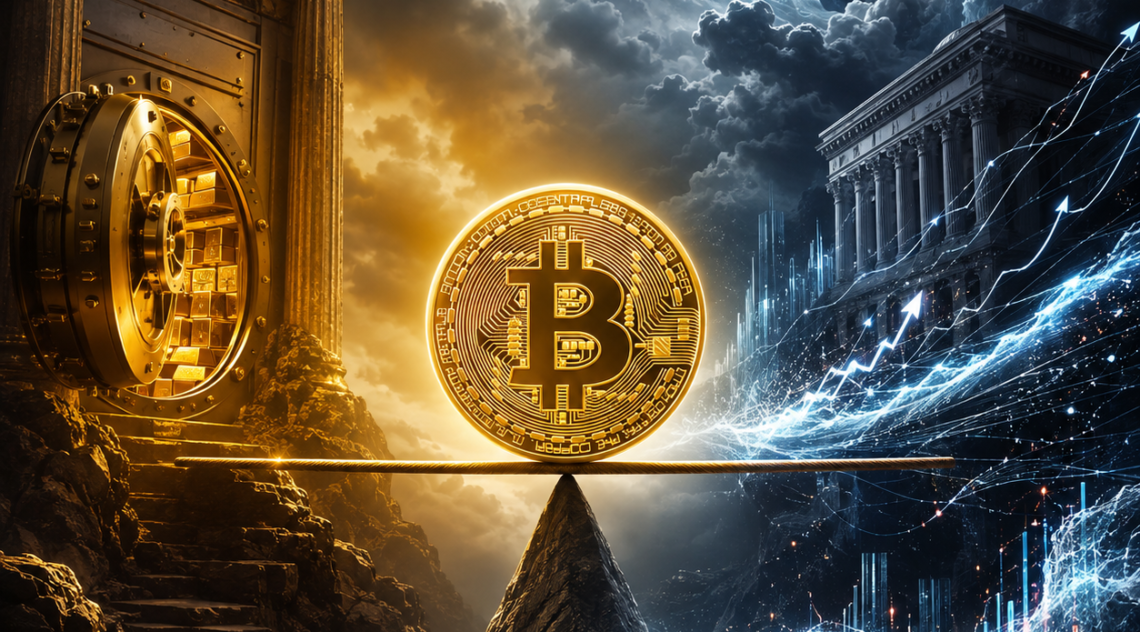

Bitcoin has spent much of its history trying to answer an identity question.
What exactly is it?
Digital money?
A speculative technology asset?
An inflation hedge?
Digital gold?
A high-risk investment?
Perhaps the answer is that Bitcoin can behave like several of these things depending on the market environment.
That debate has become especially interesting again in August 2026.
Bitcoin’s trading relationship with gold has strengthened while its correlation with technology stocks has weakened compared with earlier periods.
At the same time, Bitcoin remains highly sensitive to interest-rate expectations and Federal Reserve policy.
That creates an apparent contradiction.
How can Bitcoin become more like gold while still falling when the central bank sounds hawkish?
The answer reveals something important about what a safe-haven asset actually is.
Bitcoin Has Often Traded Like a Technology Stock
Bitcoin supporters have described it as digital gold for years.
The supply argument is easy to understand.
Bitcoin has a predefined issuance schedule and a hard maximum supply.
Governments cannot create additional BTC simply because they want to finance spending.
Gold has historically attracted investors for a similar reason.
Its supply cannot be expanded with a central-bank decision.
That makes both assets attractive to people concerned about currency debasement.
But Bitcoin’s market behavior has not always matched the narrative.
During many risk-off periods, Bitcoin fell alongside technology stocks.
When investors became optimistic, both rose.
When liquidity tightened, both suffered.
This caused critics to ask a reasonable question:
If Bitcoin behaves like a leveraged technology investment whenever markets become nervous, in what sense is it digital gold?
Correlations Are Not Permanent Identities
The mistake is assuming that an asset must always behave the same way.
Correlations change.
Gold itself does not rise during every market panic.
Government bonds do not always protect portfolios.
The dollar can strengthen or weaken depending on the source of a crisis.
Bitcoin is still a relatively young global asset.
Different groups of investors use it for different reasons.
A trader may treat BTC as a risk asset.
A corporation may hold it as a long-term treasury reserve.
A hedge fund may trade Bitcoin based on macroeconomic signals.
An individual in a country with unstable currency may view it as protection from local monetary risk.
All of these participants trade the same asset.
Their motivations are not identical.
The Debasement Trade Is Back in the Conversation
One reason the digital-gold narrative is receiving renewed attention is government debt.
The United States and several other major economies carry historically large debt burdens.
Persistent deficits raise difficult long-term questions.
Governments have several ways to manage debt.
They can increase taxes.
Reduce spending.
Grow the economy faster than debt.
Allow inflation to reduce the real value of liabilities.
Or combine several of these approaches.
Investors concerned about long-term currency purchasing power sometimes move toward scarce assets.
Gold is the traditional example.
Bitcoin increasingly appears in the same conversation.
This is often called the debasement trade.
The idea is not necessarily that a currency will collapse.
It is that assets with constrained supply may preserve value better over long periods if governments continually expand nominal money and debt.
Why Interest Rates Still Hit Bitcoin
If Bitcoin is becoming a store-of-value asset, why does Federal Reserve policy still matter so much?
Because opportunity cost matters.
Suppose short-term government securities offer attractive yields.
An investor can earn a relatively high return while taking very little credit risk.
Bitcoin produces no contractual interest payment.
Gold does not either.
When safe yields rise, non-yielding assets become relatively less attractive.
Higher rates also tighten financial conditions.
Borrowing becomes more expensive.
Liquidity can decline.
Investors may reduce exposure to volatile assets.
Bitcoin is affected by all of these forces.
Therefore, falling after hawkish Federal Reserve remarks does not automatically disprove the digital-gold thesis.
Gold itself responds to interest rates.
The real test is how Bitcoin behaves across longer periods and different macroeconomic environments.
A Safe Haven Does Not Need to Rise Every Day
The phrase “safe haven” is often misunderstood.
Some investors imagine an asset that increases every time something bad happens.
No such perfect asset exists.
A useful diversifier should behave differently enough from other portfolio assets that it can improve resilience over time.
If Bitcoin’s correlation with technology equities declines while its relationship with gold strengthens, that can matter even if BTC remains volatile.
The key question is whether the shift persists.
A few weeks of correlation data does not redefine an asset.
Several market cycles might.
Bitcoin needs to demonstrate that it can maintain demand through different combinations of inflation, recession, high interest rates and financial stress.
Volatility Remains Bitcoin’s Biggest Problem
Gold has thousands of years of monetary history.
Bitcoin does not.
Bitcoin can move several percentage points within hours.
It can experience deep drawdowns.
Leverage in crypto derivatives can amplify both rallies and crashes.
These characteristics make it difficult to describe BTC as “safe” in the conventional meaning of the word.
An investor who needs money next month should not treat a highly volatile asset as equivalent to cash.
This is where the phrase “digital gold” can become misleading.
The argument is stronger when applied to scarcity and long-term monetary characteristics than when applied to short-term price stability.
Bitcoin may become a hedge against certain financial risks while remaining risky itself.
Those ideas can coexist.
Institutional Adoption Could Change Bitcoin’s Behavior
Market structure also evolves as ownership changes.
Earlier Bitcoin markets were dominated more heavily by crypto-native traders.
Today, ETFs provide access to traditional investors.
Corporations hold BTC.
Banks are developing custody.
Asset managers analyze it alongside conventional investments.
This may gradually change how Bitcoin trades.
If more long-term investors hold BTC as portfolio insurance or a treasury asset, short-term speculative flows may become less dominant.
Alternatively, institutional integration could make Bitcoin more sensitive to the same macro forces affecting stocks and bonds.
Both outcomes are possible.
Institutional adoption does not automatically create stability.
It connects Bitcoin more deeply with global capital markets.
Bitcoin and Gold Do Not Need to Be Enemies
Crypto marketing sometimes frames Bitcoin as a replacement for gold.
That may be the wrong comparison.
Investors can own both.
Gold has physical history, established central-bank demand and deep traditional markets.
Bitcoin offers digital portability, transparent scarcity and global settlement.
The assets solve overlapping but not identical problems.
A portfolio concerned about currency debasement could theoretically contain both.
The relevant question is not which one destroys the other.
It is whether Bitcoin earns a durable place beside gold as another scarce monetary asset.
The Next Crisis Will Be the Real Test
Narratives are easy during rising markets.
Bitcoin’s safe-haven credentials will be tested during difficult ones.
What happens during a serious recession?
A sovereign-debt scare?
A banking crisis?
Persistent inflation?
A rapid tightening cycle?
A geopolitical shock?
Bitcoin has experienced versions of several of these events, but the asset and its investor base continue to evolve.
Each new macroeconomic cycle provides more evidence.
August’s market action captures the tension perfectly.
Bitcoin is increasingly being discussed alongside gold and monetary debasement.
Yet a change in Federal Reserve expectations can still send its price sharply lower.
That is not necessarily a contradiction.
It may simply mean Bitcoin is in the middle of an identity transition.
Digital gold was always a thesis.
Now the market has to prove it.