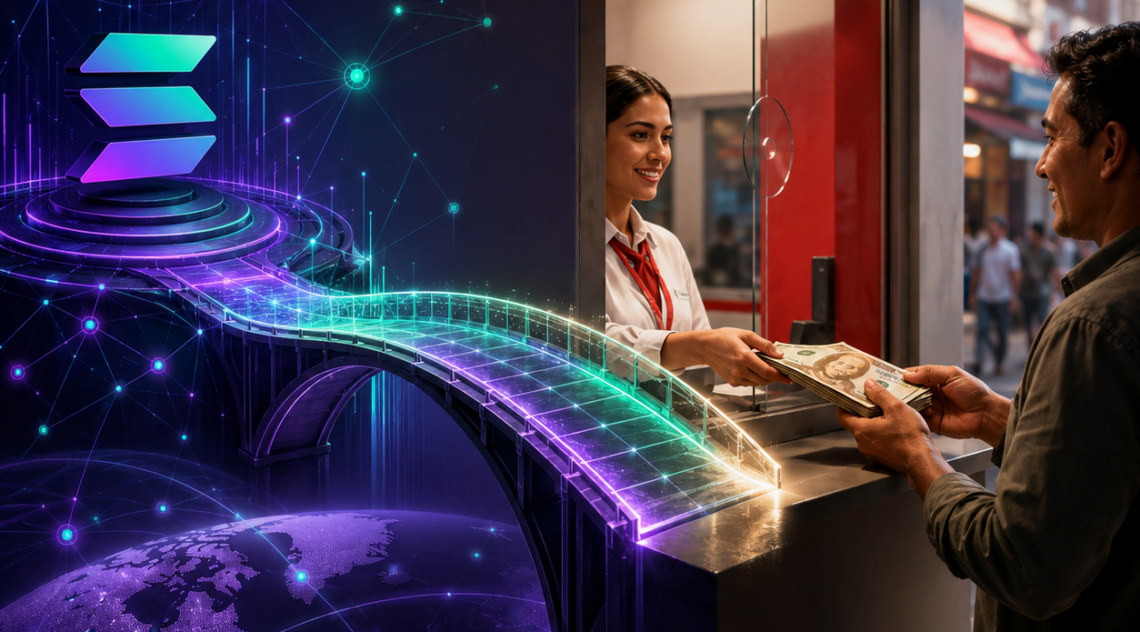

Cryptocurrency can move around the world within minutes.
Turning that cryptocurrency into cash someone can actually spend locally can be much harder.
This is one of blockchain’s most persistent contradictions.
The digital part of the transaction can be remarkably efficient.
The final connection to everyday financial life can still involve banks, cards, payment companies and physical cash networks.
MoneyGram’s expansion onto Solana illustrates how the industry is trying to solve that problem.
MoneyGram Ramps now allows supported Solana wallets and applications to connect users with cash-to-crypto and crypto-to-cash infrastructure across a large international network.
For crypto, this is more important than simply another corporate blockchain partnership.
It addresses the part of digital finance that often receives less attention:
the last mile.
Crypto Does Not Exist Entirely Online
Imagine someone receives stablecoins from a family member living abroad.
The blockchain transaction may be completed quickly.
But the recipient still has ordinary expenses.
Rent may need to be paid in local currency.
A grocery store may accept only cash or cards.
A utility provider may not recognize USDC.
The recipient therefore needs an off-ramp.
This is the process of converting blockchain-based assets back into conventional money.
Crypto companies have spent years improving on-chain transactions.
Off-ramps remain one of the areas where traditional infrastructure is still essential.
MoneyGram already operates physical and digital payment networks across many countries.
Connecting that network to blockchain applications creates a bridge between two financial worlds.
The Last Mile Is Often the Hardest Part of Payments
Moving digital information globally is easy.
Moving money between legal and financial systems is not.
Countries have different currencies.
Different banking systems.
Different identification requirements.
Different payment networks.
Different regulations.
A blockchain can transfer a token internationally.
It cannot automatically guarantee that someone in a small town can convert that token into local cash.
That requires local infrastructure.
This is why payment companies remain relevant in a supposedly decentralized financial system.
The challenge is not simply sending money.
It is making sure the recipient can actually use it.
Solana Provides the Digital Rail
Solana’s role in the integration is straightforward.
The blockchain provides fast, relatively low-cost digital infrastructure through which supported assets and applications can operate.
This makes it attractive for payment use cases.
For a small payment, transaction cost matters.
A network fee of $20 may be acceptable for a large institutional transaction.
It is unacceptable for someone sending $50 to a relative.
Likewise, users do not want to wait a long time for payment confirmation.
Blockchains hoping to support everyday payments need to combine low fees with responsive settlement.
Solana has increasingly positioned itself around those characteristics.
MoneyGram Provides Something Blockchains Cannot
MoneyGram contributes a very different asset.
Physical distribution.
A blockchain developer can build an excellent wallet without establishing cash networks across dozens of jurisdictions.
Doing so would require relationships with banks, payment processors, compliance providers and retail locations.
That infrastructure is expensive and time-consuming to build.
A service such as MoneyGram Ramps allows developers to connect with an existing network instead.
This demonstrates an important reality about mainstream crypto adoption.
The winning model may not replace every traditional financial company.
It may integrate them.
Remittances Are a Natural Use Case
International remittances are frequently mentioned as a potential blockchain application.
The reason is obvious.
Millions of people work in one country and send money to relatives elsewhere.
Traditional transfers can involve fees, currency conversion and settlement delays.
Stablecoins potentially make the digital transfer layer more efficient.
But the person receiving the funds may still need local currency.
This is where a hybrid model becomes useful.
A sender could potentially use digital assets.
Blockchain infrastructure transfers the value.
The recipient cashes out through an established payment network.
The user does not necessarily need to care which technology handled every stage.
They care about how much money arrives and how quickly they can access it.
Stablecoins Make the Model More Practical
Volatility is one reason Bitcoin has struggled as a routine payment currency.
Someone sending the equivalent of $500 does not want the value to become $460 before the recipient cashes out.
Stablecoins offer a more practical bridge.
A dollar-linked token can travel through a blockchain while attempting to maintain predictable purchasing value.
This makes stablecoins increasingly attractive for payments and remittances.
Solana supports large amounts of stablecoin activity, giving payment companies a natural settlement asset for blockchain-based transfers.
The combination of stablecoins, fast networks and local cash infrastructure could become far more important than paying directly with volatile cryptocurrencies at shops.
Cash Is Not Disappearing
Technology discussions sometimes assume physical cash is becoming irrelevant.
Globally, that is not true.
Millions of people remain underbanked.
Some workers are paid partly in cash.
Certain local economies depend heavily on physical currency.
Bank accounts are not equally accessible everywhere.
A payment innovation that works only for people with sophisticated digital banking may exclude exactly the users who could benefit most from cheaper international transfers.
That is why crypto-to-cash infrastructure matters.
It allows blockchain networks to interact with economic realities rather than assuming everyone already lives inside a fully digital financial system.
Developers Benefit From Financial Infrastructure as an API
Another important aspect is what this means for app developers.
Historically, adding financial services to an application required relationships with numerous providers.
Crypto simplified one part of that process.
A developer can integrate blockchain wallets and stablecoins through software.
Fiat access remained harder.
Services such as MoneyGram Ramps increasingly turn that traditional infrastructure into something developers can access through APIs.
This follows a broader trend in fintech.
Complex financial capabilities are becoming modular.
Identity verification becomes an API.
Payments become an API.
Custody becomes an API.
Crypto-to-cash conversion can increasingly become an API too.
That makes it easier for developers to create financial applications without rebuilding every layer from scratch.
Regulation Still Matters
None of this eliminates compliance.
Turning cash into crypto or crypto into cash creates obvious regulatory obligations.
Know-your-customer requirements may apply.
Anti-money-laundering systems matter.
Sanctions screening matters.
Companies need licenses and financial relationships.
This is another reason established payment companies can be valuable partners.
Crypto startups often have strong technology but limited regulatory infrastructure.
Traditional payment businesses already understand operating across multiple jurisdictions.
The combination can reduce friction for developers.
The Future May Be Multichain
MoneyGram’s Solana expansion is also part of a broader trend away from assuming one blockchain will dominate every financial application.
Users may hold assets on several networks.
Applications may choose different chains according to cost, speed and functionality.
Payment infrastructure increasingly needs to work across this fragmented environment.
For consumers, however, the chain itself may eventually become almost invisible.
Someone does not want a “Solana remittance.”
They want to send money.
They do not want an “Ethereum cash withdrawal.”
They want local currency.
The technology is successful when the user stops needing to understand the infrastructure underneath.
Crypto Adoption Requires an Exit as Much as an Entrance
The cryptocurrency industry has spent enormous energy helping people enter crypto.
Buy Bitcoin.
Download a wallet.
Purchase stablecoins.
Use DeFi.
But a functioning financial system also needs reliable exits.
People eventually want to spend money in the real economy.
Until every landlord, supermarket and utility provider accepts blockchain assets directly, conversion infrastructure will remain important.
That is why MoneyGram’s Solana integration matters.
It connects high-speed digital money with something stubbornly traditional: local cash.
Crypto’s future may be increasingly digital.
Its path to mainstream adoption still has to touch the physical world.